
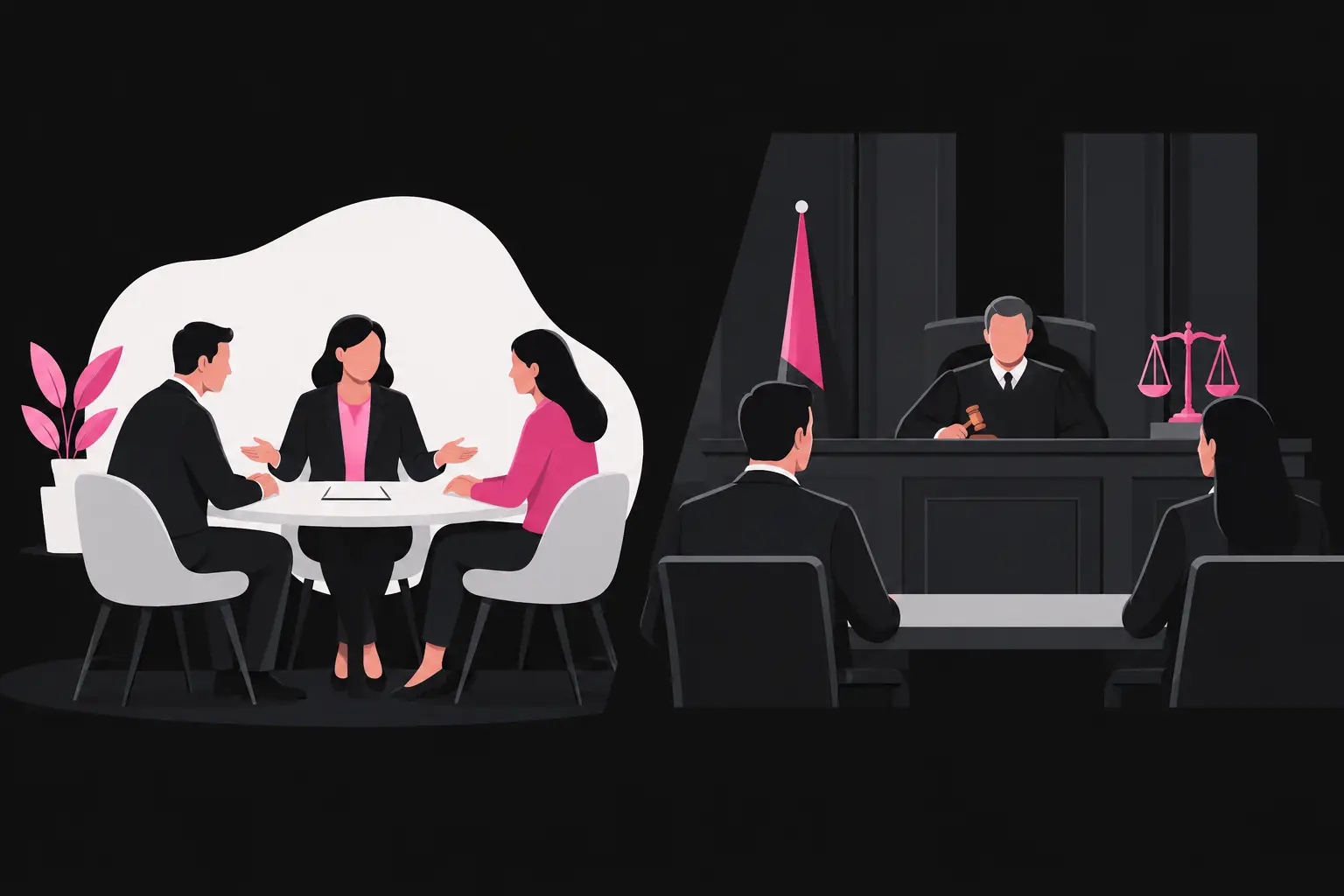
A dispute can quickly become more than the issue that started it. For a separating couple, it may affect arrangements for children and financial security. For a business, it can interrupt trading, strain a commercial relationship and absorb management time. Understanding mediation versus litigation helps you make a considered decision before positions become entrenched and costs rise.
Neither route is automatically right. Mediation can offer privacy, flexibility and a greater degree of control, while litigation may be necessary where there is a serious disagreement about legal rights, a party will not engage, or a binding court decision is required. The best approach depends on the facts, the people involved and what a satisfactory outcome needs to achieve.
What does mediation involve?
Mediation is a structured process in which an independent, neutral mediator helps people discuss their dispute and work towards an agreement. The mediator does not decide who is right or impose a result. Their role is to keep discussions constructive, identify the issues that matter and help the parties explore workable options.
It is commonly used in family, workplace, neighbour, property and commercial disputes. A mediation may take place in one meeting or over several sessions, depending on the complexity of the matter. Parties can usually agree the format, the issues to be discussed and, within reason, the timetable.
A key feature of mediation is that the parties retain control. Rather than asking a judge to choose between competing positions, they can find a solution that reflects their particular circumstances. In a commercial dispute, for example, this may include revised payment terms, future supply arrangements or an agreed exit from a contract. A court may not have the same scope to construct a practical business solution.
Mediation is generally confidential. This can be particularly valuable where family privacy, professional reputation or an ongoing business relationship is at stake. However, confidentiality is not absolute and may be subject to legal exceptions, so the terms of the process should be understood at the outset.
What does litigation involve?
Litigation is the formal process of resolving a dispute through the courts. One party brings a claim, the other responds, and the case follows procedural rules that may include pleadings, disclosure of documents, witness evidence, expert reports and a hearing. If the case does not settle, a judge makes a binding decision.
Litigation is often the appropriate route where there is no realistic prospect of voluntary agreement. It may also be needed where urgent protective action is required, such as an injunction, where a party disputes the court’s authority, or where a point of law needs a definitive determination.
The court process brings structure and enforceability. A judgment can establish liability, order payment, determine rights over property or set out other remedies available in law. This may be essential where one party has ignored their obligations or where the imbalance between the parties makes a negotiated process unsuitable.
Court proceedings are subject to strict rules and deadlines. They can be lengthy, particularly where the facts are contested or expert evidence is needed. Many civil cases settle before trial, but preparing a case properly can still require substantial time and legal costs.
Mediation versus litigation: the practical differences
The most visible difference is who controls the outcome. In mediation, the parties decide whether to settle and on what terms. In litigation, the outcome is determined by a judge if settlement cannot be reached. That judicial decision can bring certainty, but it also means accepting an outcome that neither side may have chosen.
Cost is another important consideration. Mediation is often less expensive than fully contested litigation because it can resolve issues earlier and with fewer procedural steps. That does not mean it is cost-free. There may be mediator fees, preparation time and legal advice to consider. Yet an early, well-prepared mediation can prevent a disagreement from developing into a prolonged and costly case.
Timescales also differ. A mediation can often be arranged around the parties’ availability, whereas court timetables are affected by procedural requirements and listing pressures. Where an urgent court order is needed, litigation may move quickly at first, but the wider dispute can still take considerable time to resolve.
Privacy can matter greatly. Mediation usually takes place behind closed doors, while court hearings are often public and judgments may be accessible. For individuals dealing with sensitive family issues, or businesses concerned about confidential information and reputation, that distinction may influence the choice of route.
Finally, consider the future relationship. Mediation can reduce hostility and create space for communication, which may be helpful for co-parents, neighbouring landowners, employers and employees, or trading partners who still need to work together. Litigation can be unavoidable, but an adversarial process may make rebuilding trust more difficult.
When mediation may be the better option
Mediation is most likely to help where both parties are willing to participate in good faith and there is enough information available to make informed choices. It can be particularly effective when the dispute has practical as well as legal dimensions.
For example, a family disagreement about arrangements for children may benefit from a process that allows parents to focus on routines, school, holidays and communication. In a business dispute, the parties may value preserving a supplier relationship more than proving every allegation made during the disagreement. Mediation allows room for these wider interests.
It may also be sensible where the legal position is uncertain. A negotiated agreement can remove the risk of an unfavourable judgment and provide a result sooner. That is not a sign of weakness. It is often a commercial or personal decision to avoid uncertainty, distraction and escalating expense.
An agreement reached in mediation should be recorded carefully. Depending on the matter, it may need to be incorporated into a formal settlement agreement, consent order or other legally binding document. Independent legal advice remains valuable, particularly where significant assets, children, employment rights or business obligations are involved.
When litigation may be necessary
Mediation is voluntary in the sense that a settlement cannot be forced. If a party refuses to engage meaningfully, conceals relevant information or uses the process simply to delay matters, a formal claim may be required.
Litigation may also be necessary where there are allegations of abuse, intimidation, fraud or serious misconduct; where urgent action is needed to preserve assets or prevent harm; or where there is a substantial power imbalance that cannot be managed safely. In such circumstances, the protections and authority of the court can be essential.
There are cases where principle matters as much as compromise. A landlord, employer, shareholder or property owner may need clarity on a legal right that will affect future decisions. A court judgment can provide that clarity, although it should be pursued with a realistic understanding of the evidence, risk and potential costs consequences.
The relevant legal process can differ between Northern Ireland and the Republic of Ireland. In cross-border matters, questions about jurisdiction, applicable law and enforcement should be addressed early. Obtaining advice at the outset can avoid spending time and money in the wrong forum.
It is not always a choice between one or the other
Mediation and litigation are not opposing routes that can never meet. A dispute may begin with solicitor-led negotiation, move to mediation, and proceed to court only if a settlement cannot be reached. Equally, parties already involved in court proceedings can mediate at a later stage.
This flexible approach is often sensible. Preparing for mediation with clear legal advice helps a party understand their rights, assess the strength of their position and recognise what a reasonable settlement may look like. Preparing a case for litigation can also encourage constructive negotiation when each side appreciates the risks of continuing.
Before choosing a route, focus on the outcome you need, the urgency of the situation, the other party’s willingness to engage and the value of preserving the relationship. A solicitor can help assess those factors, explain the likely process and protect your position while pursuing an efficient resolution.
A dispute rarely improves by being left to harden. Early, measured advice can give you the confidence to negotiate where agreement is possible and to take firm action where it is not.